
INTERVAL AND SET-BUILDER NOTATION
Copyright by Ingrid Stewart, Ph.D. Please Send Questions and Comments to ingrid.stewart@csn.edu.
What is discussed in this lecture?
1. Interval Notation
2. Set-Builder Notation
Both the Interval and Set-Builder Notations are used to efficiently express a certain span of numbers on the number line.
1. Interval Notation
In Interval Notation, we use parentheses, brackets, and sometimes the "union" symbol.
Brackets [ ] : In Interval Notation, a bracket next to a number indicates that the number is included in the solution interval.
For example,
would be a representation of the interval on the number line between
and
inclusive.
NOTE: When using Interval Notation, the smaller number is ALWAYS written first, followed by the larger number.
would NOT be a correct representation of the interval.
Parentheses ( ) : In Interval Notation, a parenthesis next to a number indicates that the number is NOT included in the solution interval. Negative and positive infinity always start or end, respectively, with a parenthesis.
For example,
would be a representation of the interval on the number line between
For example,
or
or
would be a representation of intervals including the infinity symbol.
Union
 :
In Interval Notation, the symbol
joins two intervals of numbers.
:
In Interval Notation, the symbol
joins two intervals of numbers.
For example,
would be a representation of two joined intervals on the number line. The first interval represents the numbers between
and
and
, but not include the numbers.
2. Set-Builder Notation
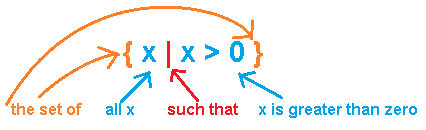
In Set-Builder Notation we use mathematical symbols, braces, and a vertical bar separator.
Mathematical Symbols:
>, <,
 ,
,
 ,
,  ,
, 
> means "greater than"
< means "less than"
means "not equal to"
Braces { } : In Set-Builder Notation, a brace starts and ends the set.
Vertical bar | : In Set-Builder Notation, the vertical bar is translated into English as "such that".
Example 1:
Write
in Interval and Set-Builder Notation.
Interval Notation:

It is an open interval along the x-axis starting at 2, but not including 2 and going to 6, but not including 6.
Note that the smaller number is always written first!Set-Builder Notation:
Read the part in braces as "the set of all x such that x is greater than 2 but less than 6."
Example 2:
Write
in Interval and Set-Builder Notation.
Interval Notation:
It is a closed interval along the x-axis starting at 2 inclusive and going to 6 inclusive.
Set-Builder Notation:
Read the part in braces as "the set of all x such that x is greater than or equal to 2 but less than or equal to 6."
Example 3:
Write
in Interval and Set-Builder Notation.
Interval Notation:
It is a half-open interval along the x-axis starting at 2 inclusive and going to 6, but not including 6.
Set-Builder Notation:
Read the part in braces as "the set of all x such that x is greater than or equal to 2 but less than 6."
Example 4:
Write
in Interval and Set-Builder Notation.
Interval Notation:
It is a interval along the x-axis starting at 2, but not including 2, and extending to positive infinity.
Negative and positive infinity always start or end, respectively, with a parenthesis.
Note that the smaller number is always written first! In this case 2 is smaller than positive infinity.Set-Builder Notation:
Read the part in braces as "the set of all x such that x is greater than 2".
Example 5:
Write
in Interval and Set-Builder Notation.
Interval Notation:
It is an interval along the x-axis starting at negative infinity and extending to 2, but not including 2.
Negative and positive infinity always start or end, respectively, with a parenthesis.
Note that the smaller number is always written first! In this case, negative infinity is smaller than 2.Set-Builder Notation:
Read the part in braces as "the set of all numbers x such that x is less than or equal to 2".
Example 6:
Write All Real Numbers in Interval and Set-Builder Notation.
Interval Notation:
It is an interval along the x-axis starting at negative infinity and extending to positive infinity
Set-Builder Notation:
Read the part in braces as "the set of all x such that x consists of all rational and irrational numbers.
Example 7:
Write All Real Numbers except 1 and 5 in Interval and Set-Builder Notation.
Interval Notation:
Here we had to write three separate intervals and them join them with a union symbol in order to leave out the numbers 1 and 5.
Set-Builder Notation:
When we leave out a few finite number, it is easier to write th interval in Set-Builder Notation. Read the part in braces as "the set of all x such that x is not equal to 1 and not equal to 5."
Example 8:
Write
but
in Interval and Set-Builder Notation.
Interval Notation:
Here we had to write two separate intervals and then join them with a union symbol in order to leave out the number 0.
Set-Builder Notation:
Read the part in braces as "the set of all x such that x is less than 2 and not equal to 0."











