POINTS, LINES, PLANES, AND ANGLES
Copyright by Ingrid Stewart, Ph.D. Please Send Questions and Comments to ingrid.stewart@csn.edu.
What is discussed in this lecture?
1. Introduction to Geometry
2. Some Definitions
3. Introduction to Angles
4. Angle Measure
5. Naming of Angles
6. Special Angles
7. Measuring Angles
8. Relationships Among Angles Formed by Intersecting Lines
1. Introduction to Geometry
Geometry, from the Ancient Greek "geo" (earth) and "metron" (measurement), is a branch of mathematics concerned with questions of shape and space. The fundamental objects of geometry are points, lines, and planes. Angles and curves are also critical to the study of geometry because they play an important role in creating three-dimensional shapes. Studying the shape of our world will provide us with an abundance of practical applications. You can tile your house, buy carpet, build a brick wall, or determine how much money to save before purchasing that granite countertop for your new kitchen. Geometry is found everywhere: in construction, landscaping, art, architecture, astronomy, engineering, surveying, machines, tool making, cars and much more.
2. Some Definitions
Point
A point is a small dot. It has no length, width, or thickness.
Plane
A plane is a flat surface with no boundaries and no thickness.
Line
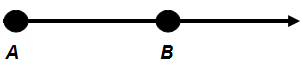
A line extends indefinitely in both directions indicated by arrows. A line can be identified by naming any two points on the line, for example, A and B. The notation for a line that extends through points A and B is
(in alphabetic order).
Parallel Lines
Lines that never intersect.
Intersecting Lines
Lines that have a point in common.
Perpendicular Lines
Lines that intersect at a 90
angle.
Line Segment
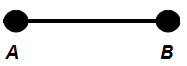
A line segments starts and stops at distinct points called endpoints. A line segment can be identified by its endpoints, for example, A and B. The notation for a line segment that includes the points A and B is
(in alphabetic order).
Ray
A ray consists of a point on a line and all subsequent points on one side of the point. The point from which the ray originates is called the endpoint. A ray is named by its endpoint and any other point on the ray, for example, A and B. The notation for a ray that includes the points A and B is
(in alphabetic order)
3. Introduction to Angles
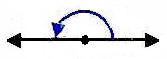
An angle is determined by rotating a ray about its endpoint. The starting position of the ray is the initial side of the angle, and the position after rotation is the terminal side of the angle. The terminal and initial side are also called arms of the angle. The point where the initial and the terminal side meet is called the vertex of the angle.

NOTE: When drawing an angle, the rotation of the ray about its endpoint is usually indicated with an arc in between the initial and terminal sides.
4. Angle Measure
Most commonly, angles are measured in degrees. This is indicated by the degree sign o next to a number. For example, 45o.
Degrees can further be divided into minutes ( ' ) and seconds ( " ). That is,
1o = 60' (minutes) using the apostrophe on the computer keyboard
1' = 60" (seconds) using the quotation mark on the keyboard
Angles can be named in several ways. In this course we are going to use three different ways. We'll show them by using the following picture:

- We can place a number or letter in between the two rays, say 1, and then name the angle
1 using the symbol
- We can also use the letters of points on the rays together with the vertex point. That is,
- Finally, we can use the letter for the vertex point alone as long as it is perfectly clear which angle is designated by this letter. In the picture above, it is quite clear which angle we mean when we say
Example 1:
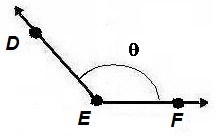
a. Express the angle indicated above in two different ways using three capital letters.
b. Express the angle indicated above using one capital letter.
c. Express the angle indicated above using the Greek letter θ (theta).
6. Special Angles
0o (Zero)-Degree Angle
One ray indicates the initial and the terminal side.
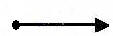
360-Degree Angle
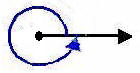
NOTE: Unlike with the 0o angle, there is a curved angle indicator showing that the terminal side moved through a rotation of 360o.
Right Angles
Angles whose measure is exactly 90o.

Please note that the RIGHT ANGLE is usually indicated by a rectangle drawn between the terminal and initial side.
Straight Angles
Angles whose measure is exactly 180o.
Acute Angles
Angles whose measure is greater than 0obut less than 90o.
Obtuse Angles
Angles whose measure is greater than 90o but less than 180o.
Reflex Angles
Angles whose measure is greater than 180o
Example 2:
Classify the given angles as right, straight, acute, obtuse, reflex:
a. 38o - acute angle because the measure is greater than 0o but less than 90o
b. 95o - obtuse angle because the measure is greater than 90o but less than 180o
c. 90o - right angle
d. 153o - obtuse angle because the measure is greater than 90o but less than 180o
e. 10o - acute angle because the measure is greater than 0o but less than 90o
f. 180o - straight angle
g. 270o - reflex angle
Complementary Angles
Two angles are called complementary when their sum is 90o.
Supplementary Angles
Two angles are called supplementary when their sum is 180o.
Example 3:
Tell whether the angle pairs are complementary, supplementary, or neither.
a. 42o, 80o - sum equals 122o, which is neither complementary (90o) nor supplementary (180o)
b. 17o, 73o - sum equals 90o, therefore, angles are complementary
c. 38o, 142o - sum equals 180o, therefore, angles are supplementary
d. 52o, 48o - sum equals 100o, which is neither complementary (90o) nor supplementary (180o)
e. 60o, 30o - sum equals 90o, therefore, angles are complementary
f. 110o, 70o - sum equals 180o, therefore, angles are supplementary
7. Measuring Angles
We use a semicircular protractor to measure angles. Below is a picture of one type.
Measuring Procedure:
- Place the base of the protractor along one side of the angle with the point on your protractor that indicates its "center" on the vertex of the angle. Please note that the "center" of the protractor is somewhere along or close to the base of the protractor. Be very careful! Not all protractors have user-friendly centers.
- Depending on the location of the other side of the angle, either choose the scale that has the zero-degree reading on the right side of the protractor or on the left side. Read the measurement where this side crosses the scale of the protractor.

The measure of angle O is 40o.
8. Relationships Among Angles Formed by Intersecting Lines
Below is the picture of two intersecting lines.
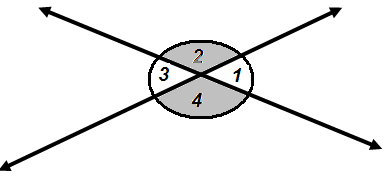
In the picture above,
The measures of vertical angles are equal.
When we discuss the measure of an angle, traditionally the letter m is placed before the angle symbol.
Therefore,
m
m
The sum of the measures of adjacent angles equal 180o.
Therefore,
m
m
m
m
Example 4:
In the figure shown below, you are given the measure of two angles. Find the measure of the remaining angles.
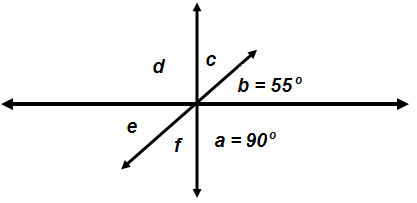
Angles a and d are opposite angles. Therefore, m
Angles b and c are complementary angles. Therefore, m
55o = 35o.
Angles b and e are opposite angles. Therefore, m
Angles c and f are opposite angles. Therefore, m