
INTERVAL AND SET-BUILDER NOTATION
Copyright by Ingrid Stewart, Ph.D. Please Send Questions and Comments to ingrid.stewart@csn.edu.
What is discussed in this lecture?
1. Interval Notation
2. Set-Builder Notation
Both the Interval and Set-Builder Notations are used to efficiently express a certain span of numbers on the number line.
1. Interval Notation
In Interval Notation, we use parentheses, brackets, braces, and sometimes the "union" symbol.
Braces { } : In Interval Notation, a number surrounded by braces indicates that it is the only value in the interval.
For example, { 4 } would be a representation of an interval that just includes one number.
Brackets [ ] : In Interval Notation, a bracket next to a number indicates that the number is included in the solution interval.
For example,
would be a representation of the interval on the number line between
and
inclusive.
NOTE: When using Interval Notation, the smaller number is ALWAYS written first, followed by the larger number.
would NOT be a correct representation of the interval.
Parentheses ( ) : In Interval Notation, a parenthesis next to a number indicates that the number is NOT included in the solution interval. Negative and positive infinity always start or end, respectively, with a parenthesis.
For example,
would be a representation of the interval on the number line between
For example,
or
or
would be a representation of intervals including the infinity symbol.
Union
 :
In Interval Notation, the symbol
joins two intervals of numbers.
:
In Interval Notation, the symbol
joins two intervals of numbers.
For example,
would be a representation of two joined intervals on the number line. The first interval represents the numbers between
and
and
, but not include the numbers.
2. Set-Builder Notation
In Set-Builder Notation we use mathematical symbols, braces, and a vertical bar separator.
Mathematical Symbols:
>, <,
 ,
,
 ,
,  ,
, 
> means "greater than"
< means "less than"
means "not equal to"
Braces { } : In Set-Builder Notation, a brace starts and ends the set.
Vertical bar | : In Set-Builder Notation, the vertical bar is translated into English as "such that".
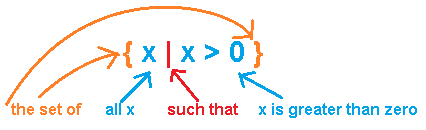
For the examples below, we need to keep in mind a number line as follows:

Please note that there are infinitely many negative and positive numbers, not just the integers we see in the picture. Often, you will see the following two symbols at the ends of a numberline;
 (negative infinity) and
  (positive infinity)
They indicate that numbers will go on and on to infinity in both directions.
Example 1:
Write
in Interval and Set-Builder Notation.
In English, we are asked the following: "Find all numbers x that are less than 6, but greater than 2."
Interval Notation:

It is an open interval along the x-axis starting at 2, but not including 2 and going to 6, but not including 6. That is why we use parentheses ( and ). Note that the smaller number is always written first!
Set-Builder Notation:
Read the part in braces as "the set of all x such that x is greater than 2 but less than 6."
Example 2:
Write
in Interval and Set-Builder Notation.
In English, we are asked the following: "Find all numbers x that are less than or equal to 6, but greater than or equal to 2."
Interval Notation:
It is a closed interval along the x-axis starting at 2 inclusive and going to 6 inclusive. That is why we use brackets [ and ].
Set-Builder Notation:
Read the part in braces as "the set of all x such that x is greater than or equal to 2 but less than or equal to 6."
Example 3:
Write
in Interval and Set-Builder Notation.
In English, we are asked the following: "Find all numbers x that are less 6, but greater than or equal to 2."
Interval Notation:
It is a half-open interval along the x-axis starting at 2 inclusive and going to 6, but not including 6. That is why we use a bracket [ next to the 2 and a parenthesis ) next to the 6.
Set-Builder Notation:
Read the part in braces as "the set of all x such that x is greater than or equal to 2 but less than 6."
Example 4:
Write
in Interval and Set-Builder Notation.
In English, we are asked the following: "Find all numbers x that are greater than 2."
Interval Notation:
It is a interval along the x-axis starting at 2, but not including 2, and then including ALL numbers thereafter, that is, infinitely many numbers. Negative and positive infinity always start or end, respectively, with a parenthesis.
Note that the smaller number is always written first! In this case 2 is smaller than positive infinity.Set-Builder Notation:
Read the part in braces as "the set of all x such that x is greater than 2".
Example 5:
Write
in Interval and Set-Builder Notation.
Please note that this example is identical to Example 4.
Example 6:
Write
in Interval and Set-Builder Notation.
In English, we are asked the following: "Find all numbers x that are less than or equal to 2."
Interval Notation:
It is an interval along the x-axis starting at negative infinity and extending to 2 and including 2.
Negative and positive infinity always start or end, respectively, with a parenthesis.
Note that the smaller number is always written first! In this case, negative infinity is smaller than 2.Set-Builder Notation:
Read the part in braces as "the set of all numbers x such that x is less than or equal to 2".
Example 7:
Write All Real Numbers in Interval and Set-Builder Notation.
Interval Notation:
It is an interval along the x-axis starting at negative infinity and extending to positive infinity.
Set-Builder Notation:
Read the part in braces as "the set of all x such that x consists of all rational and irrational numbers.
Example 8:
Write All Real Numbers except 1 and 5 in Interval and Set-Builder Notation.
Interval Notation:
Here we had to write three separate intervals and them join them with a union symbol in order to leave out the numbers 1 and 5.
Set-Builder Notation:
When we leave out a few finite number, it is easier to write th interval in Set-Builder Notation. Read the part in braces as "the set of all x such that x is not equal to 1 and not equal to 5."
Example 9:
Write
but
in Interval and Set-Builder Notation.
Interval Notation:
Here we had to write two separate intervals and then join them with a union symbol in order to leave out the number 0.
Set-Builder Notation:
Read the part in braces as "the set of all x such that x is less than 2 and not equal to 0."











